

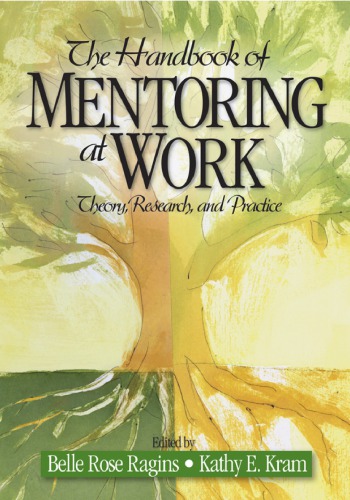
The Handbook of Mentoring at Work Theory Research and Practice 1st Edition by Belle Rose Ragins, Kathy E Kram ISBN 1412916690 9781412916691


Original price was: $50.00.$35.00Current price is: $35.00.
The Handbook of Mentoring at Work Theory Research and Practice 1st Edition by Belle Rose Ragins, Kathy E. Kram – Ebook PDF Instant Download/Delivery: 1412916690, 9781412916691
Full download The Handbook of Mentoring at Work Theory Research and Practice 1st Edition after payment
Product details:
ISBN 10: 1412916690
ISBN 13: 9781412916691
Author: Belle Rose Ragins, Kathy E. Kram
“This handbook is remarkable in that it provides a comprehensive and finely nuanced account of the diverse approaches that researchers, theorists,and practitioners have taken to mentoring by incorporating insights of someof the most widely known and respected researchers in careers and in mentoring…This handbook is poised to become a classic in career and mentoring literature with its potential long-term heuristic usefulness in generating new intersections among theory, research, and practice.”
—Rebecca L. Weiler, Suzy D’Enbeau, Patrice M. Buzzanell, Purdue University
“This handbook is poised to become a classic in career and mentoring literature with its potential long-term heuristic usefulness in generating new intersections among theory,research, and practice…it is encouraging that so much of the handbook establishes grounds for future communication research and relates directly to current trends in organizational and managerial communication.”
—MANAGEMENT COMMUNICATION QUARTERLY
“Ragins and Kram—both scholars whose work ignited the field of mentoring some 20 years ago and has guided it ever since—have teamed up to produce this lucid and accessible compendium of research and theory on mentoring relationships at work. Bringing together an impressive group of scholars, this volume offers a comprehensive assessment of the current state of knowledge about mentoring, as well as an ambitious, theory-driven, practice-oriented agenda for future research. This book is an essential resource and could not be more timely as organizational scholars and practitioners alike grapple with the challenges of developing an ever more diverse workforce to meet the needs of an ever more global and technologically sophisticated organizational world.”
—Robin Ely, Harvard Business School
“The most complete [reference] in mentoring. The most seminal thinkers and the most significant collection of essays in print. A must read for everyone concerned with growth and learning.”
—Warren Bennis, University of Southern California
“This book is extremely timely. After two decades of research and debate, it provides a definitive guide to the study and practice of mentoring. In a world of looming talent shortages, it will prove an invaluable resource to reflective practitioners and organizational scholars alike. The authors should be congratulated for offering this tour de force of cutting-edge research and practice on mentoring while also charting new territories for future investigation.”
—Herminia Ibarra, INSEAD
“From two of the leading theorists in the field of mentoring comes an extraordinary volume. Ragins and Kram have guided a stellar group of authors toward new heights in theory and practice. The book covers all the bases and provides multiple perspectives–some entirely new—that promise to be generative of innovative research and practice. No one interested in mentoring, neither scholar nor practitioner, can afford to ignore this remarkable book.”
—Lotte Bailyn, MIT Sloan School of Management
“The explosion of interest in workplace mentoring today cries out for more robust research frameworks as well as new and better practical applications. This superb Handbook closes that gap by bringing together leading scholars and practitioners for a comprehensive overview of this fast-growing phenomenon. Researchers, students, human resources professionals and practicing managers alike–indeed, anyone who has been a mentor or mentee–will find this groundbreaking volume an indispensable companion.”
—John Alexander, Former President and Senior Advisor, Center for Creative Leadership
The Handbook of Mentoring at Work: Theory, Research, and Practice brings together the leading scholars in the field in order to craft the definitive reference book on workplace mentoring. This state-of-the-art guide connects existing knowledge to cutting-edge theory, research directions, and practice strategies to generate the “must-have” resource for mentoring theorists, researchers, and practitioners. Editors Belle Rose Ragins and Kathy E. Kram address key debates and issues and provide a theory-driven road map to guide future research and practice in the field of mentoring.
Key Features
- Takes a three-pronged approach: Organized into three parts—Research, Theory, and Practice. Breaks new theoretical ground in a time of change: The theory section extends the theoretical horizon by providing perspectives across related disciplines in order to enrich, enliven, and build new mentorship theory.
- Makes sense of research and planning new directions: The research part brings together leading scholars for the dual purpose of chronicling the current state of research in the field of mentoring and identifying important new areas of research.
- Builds bridges between research and practice: The practice part brings together leading mentoring practitioners to connect theory and research to practice, specifically, addressing how mentoring has changed over the past 20 years.
- Offers coherence within and across each section: At the beginning of each part, the editors provide a roadmap of the main themes—how they relate to one another, as well as to other parts of the book.
- Examines the impact of the changing landscape of careers: Framed within the new career landscape, the book incorporates changes in diversity, organizational structure, and technology.
Intended Audience This complete and comprehensive volume defines the current state of the field, making it the ultimate resource for scholars, students, and practitioners pursuing research on mentoring and related phenomena. It can also be used as a core or supplementary text in graduate courses on mentoring in the fields of business & management, industrial & organizational psychology, education, social work, health care, nursing, communication, sociology, and criminal justice.
Table of contents:
Section I. Introduction
Chapter 1. The Roots and Meaning of Mentoring
Section II. Mentoring Research: Past, Present, and Future
Chapter 2. The Role of Personality in Mentoring Relationships: Formation, Dynamics, and Outcomes
Chapter 3. Mentoring and Career Outcomes: Conceptual and Methodological Issues in an Emerging Literature
Chapter 4. Mentoring as a Forum for Personal Learning in Organizations
Chapter 5. Mentoring Relationships from the Perspective of the Mentor
Chapter 6. Mentoring and Leadership: Standing at the Crossroads of Theory, Research, and Practice
Chapter 7. Mentoring and Organizational Socialization: Networks for Work Adjustment
Chapter 8. Gender and Mentoring: Issues, Effects, and Opportunities
Chapter 9. Unfinished Business: The Impact of Race on Understanding Mentoring Relationships
Chapter 10. Formal Mentoring Programs: A “Poor Cousin” to Informal Relationships
Chapter 11. Peer Mentoring Relationships
Chapter 12. E-Mentoring: Next Generation Research Strategies and Suggestions
Chapter 13. Understanding Relational Problems in Mentoring: A Review and Proposed Investment Model
Section III. Mentoring Theory: Applying New Lenses and Perspectives
Chapter 14. Developmental Initiation and Development Networks
Chapter 15. Stone Center Relational Cultural Theory: A Window on Relational Mentoring
Chapter 16. A Constructive-Developmental Theoretical Approach to Mentoring Relationships
Chapter 17. The Role of Emotional Intelligence in the Mentoring Process
Chapter 18. Mentoring for Intentional Behavioral Change
Chapter 19. Career Cycles and Mentoring
Chapter 20. Mentoring Enactment Theory: Describing, Explaining, and Predicting Communication in Mentoring Relationships
Chapter 21. Mentoring and the Work–Family Interface
Section IV. Mentoring in Practice: Programs and Innovations
Chapter 22. Advancing Women Through the Glass Ceiling with Formal Mentoring
Chapter 23. Designing Relationships for Learning into Leader Development Programs
Chapter 24. The Practice of Mentoring: MENTTIUM Corporation
Chapter 25. Blind Dates? The Importance of Matching in Successful Formal Mentoring Relationships
Chapter 26. An International Perspective on Mentoring
Section V. Integration
Chapter 27. The Landscape of Mentoring in the 21st Century
People also search for:
ragins & kram 2007 the handbook of mentoring at work
what is a mentor in the workplace
the role of a mentor in the workplace
the handbook of mentoring at work theory research and practice
mentoring handbook pdf
Tags: Belle Rose Ragins, Kathy E Kram, Handbook of Mentoring, Work, Theory, Research, Practice