

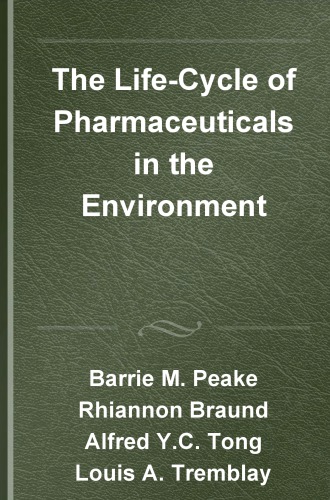
The Life Cycle of Pharmaceuticals in the Environment 1st Edition by Barrie M Peake, Rhiannon Braund, Alfred Y C Tong, Louis A Tremblay ISBN 190881845X 9781908818454
Original price was: $50.00.$35.00Current price is: $35.00.
The Life Cycle of Pharmaceuticals in the Environment 1st Edition by Barrie M. Peake, Rhiannon Braund, Alfred Y. C. Tong, Louis A. Tremblay – Ebook PDF Instant Download/Delivery: 190881845X, 9781908818454
Full download The Life Cycle of Pharmaceuticals in the Environment 1st Edition after payment
Product details:
ISBN 10: 190881845X
ISBN 13: 9781908818454
Author: Barrie M. Peake, Rhiannon Braund, Alfred Y. C. Tong, Louis A. Tremblay
The Life-Cycle of Pharmaceuticals in the Environment identifies pathways of entry of pharmaceuticals into the environment, beginning with the role of global prescribing and disposal practices. The book then discusses typical levels of common pharmaceuticals and how they can be determined in natural waters such as raw and treated sewage, and in potable water. In addition, sections examine methods currently available to degrade pharmaceuticals in natural waters and some of their ecotoxicological impacts, along with future considerations and the growing concept of product stewardship.
Table of contents:
1: Introduction
1.1 Overview: Do pharmaceuticals pose a significant environmental risk?
1.2 Hazardous substances
1.3 Pathways to the environment: Life-cycle of pharmaceuticals
1.4 Conclusions
2: Prescribing Practices
2.1 Pharmaceuticals in legislative and healthcare systems
2.2 The role of patient medical adherence
2.3 Strategies to minimize medication nonadherence
2.4 “Doctor, it just doesn’t work!”—Pharmacodynamics, pharmacokinetics, and pharmaceutical waste
2.5 “How much are those antibiotics? I want ’em!”
2.6 Accumulation of unused medications
2.7 Strategies to prevent accumulation of unused pharmaceuticals
3: Disposal of Unused Medications
3.1 Overview
3.2 The origins of unused medication
3.3 Medication disposal by households
3.4 Attitudes toward medication disposal
3.5 Feasibility of take-back programmes for unused medication
3.6 Management of pharmaceutical waste at take-back depots
3.7 The “best” method for the disposal of unused medications?
3.8 Conclusions
4: Detection and Presence of Pharmaceuticals in the Environment
4.1 Overview
4.2 Environmental detection of pharmaceuticals
4.3 Sample collection
4.4 Sample extraction
4.5 Chromatographic separation of environmental sample extracts
4.6 Mass spectrometric detection and quantitation
4.7 Environmental concentrations of some common pharmaceuticals
4.8 Summary
5: Impact of Pharmaceuticals on the Environment
5.1 Overview
5.2 Environmental risk assessment methodologies
5.3 Experimental variables involved in risk assessment
5.4 Ecotoxicology
5.5 Mixture toxicity
5.6 Case study: Paracetamol (acetaminophen) in the environment
5.7 Case study: Fluoxetine in the environment
5.8 Case study: Diclofenac in the environment
5.9 Summary
6: Degradation of Pharmaceuticals in Wastewater
6.1 Basic steps in wastewater treatment
6.2 Removal and degradation of selected human pharmaceuticals
6.3 Effect of the natural organic matrix on pharmaceutical removal and degradation in wastewater
6.4 Summary and conclusions
7: Regulatory Practices to Control the Discharge of Pharmaceuticals into the Environment
7.1 Overview
7.2 The United States of America and Canada
7.3 European Union (EU)
7.4 China and other parts of Asia
7.5 Australia
7.6 New Zealand
7.7 Challenges and conclusions
8: Green Chemistry, Green Pharmacy, and Life-Cycle Assessments
8.1 Green chemistry and green pharmacy
8.2 Life-Cycle Assessment (LCA)
8.3 Summary
9: Summary and Conclusions
9.1 The potential environmental risk of pharmaceuticals?
9.2 Some possible future considerations
People also search for:
the life cycle of pharmaceuticals in the environment
the environmental impact of the pharmaceutical industry
pharmaceutical life cycle of a product
pharmaceutical life cycle management
the life-cycle of pharmaceuticals in the environment
Tags: Barrie M Peake, Rhiannon Braund, Alfred Y C Tong, Louis A Tremblay, Life Cycle, Pharmaceuticals, Environment