

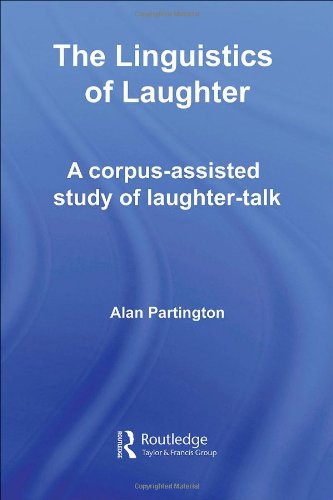
The Linguistics of Laughter A corpus assisted Study of Laughter talk Routledge Studies in Linguistics 1st Edition by Alan Partington 9781134178117 1134178115

Original price was: $50.00.$35.00Current price is: $35.00.
The Linguistics of Laughter A corpus assisted Study of Laughter talk Routledge Studies in Linguistics 1st Edition by Alan Partington – Ebook PDF Instant Download/Delivery: 9781134178117, 1134178115
Full download The Linguistics of Laughter A corpus assisted Study of Laughter talk Routledge Studies in Linguistics 1st Edition after payment
Product details:
ISBN 10: 1134178115
ISBN 13: 9781134178117
Author: Alan Partington
The Linguistics of Laughter examines what speakers try to achieve by producing ‘laughter-talk’ (the talk preceding and eliciting an episode of laughter) and, by using abundant examples from language corpora, what hearers are signalling when they produce laughter. In particular, Alan Partington focuses on the tactical use of laughter-talk to achieve specific rhetorical, and strategic, ends: for example, to construct an identity, to make an argumentative point, to threaten someone else’s face or save one’s own. Although laughter and humour are by no means always related, the book also considers the implications these corpus-based observations may have about humour theory in general. As one of the first works to have recourse to such a sizeable databank of examples of laughter in spontaneous running talk, this impressive volume is an essential point of reference and an inspiration for scholars with an interest in corpus linguistics, discourse, humour, wordplay, irony and laughter-talk as a social phenomenon.
The Linguistics of Laughter A corpus assisted Study of Laughter talk Routledge Studies in Linguistics 1st Table of contents:
Introduction Laughter-talk — research questions and methods
I.1 Aims
I.2 Press briefings
I.3 Corpus-Assisted Discourse Studies
I.3.1 Quantitative and qualitative approaches combined
I.3.2 Corpus-Assisted Discourse Studies methodology
I.3.3 Some frequency data
I.3.4 Concordancing
I.3.5 Serendipity
I.4 Definitions and descriptions of laughter types
I.5 Literature on laughter in discourse
I.6 Literature on laughter in politics
I.7 Laughter: what the corpus says
I.8 Laughter: humorous and non-humorous
I.9 Outline of the work and the research questions we confront
1 Joke humour theory and language principles
1.1 Bisociation
1.1.1 Koestler and The Act of Creation
1.1.2 The Semantic Script Theory of jokes
1.2 Script theory
1.3 A script-and-inference theory of jokes
1.3.1 From script to narrative
1.3.2 Script and non-script narratives in jokes
1.3.3 What kind of incongruity is funny?
1.3.4 Oppositeness
1.3.5 Logical mechanisms
1.3.6 The proper- improper narrative shift
1.3.7 Reversal of evaluation
1.3.8 The absurd, the abnormal and quirky logic in jokes
1.4 Scripts and logical analysis/inferencing in language processing: lexicogrammar
1.4.1 Open choice and inferencing
1.4.2 The idiom principle and script-recall
2 Laughter in running discourse Shifts of mode, narrative, role and register
2.1 Briefings as institutional talk
2.2 Transaction and interaction in institutional talk
2.2.1 Transaction in the briefings
2.2.2 Interaction in the briefings
2.3 Play
2.4 Narratives and role play
2.4.1 Repeated narratives
2.4.2 Occasional narratives
2.4.3 Evaluation reversal
2.5 Register play
2.5.1 Definitions
2.5.2 Transaction to interaction and back again
2.6 Bathos and upgrading
2.7 Colourful language
2.8 Conclusion
3 Face-work and the in-group
3.1 Introduction
3.2 Politeness theory and face
3.2.1 The model
3.2.2 Threatening face
3.2.3 Face in lexicography and corpora
3.2.4 Positive face and the in-group
3.3 Politeness and laughter
3.4 Threatening the other’s face
3.5 Conclusions
4 Wordplay, phraseplay and relexicalization
4.1 Linguistic research into wordplay
4.2 Defining the pun
4.2.1 Identity and resemblance
4.2.2 Near puns
4.2.3 Exact puns
4.2.4 Good puns and bad? Motivation
4.2.5 Derivation and disruption
4.3 A linguistic account of wordplay
4.3.1 Collocation and semantic preference
4.3.2 Relexicalization of preconstructed phrases
4.3.3 Delexicalization
4.3.4 Reconstruction of an original version
4.4 Metanalysis
4.5 Corpus data 1: puns in newspaper headlines
4.5.1 Exact puns in headlines
4.5.2 Non-exact puns in headlines
4.5.3 Verbal cascading
4.6 Corpus data 2: wordplay in interactive discourse
4.6.1 The importance of wording: playing with definitions
4.6.2 Scripted puns
4.6.3 Unscripted or spontaneous wordplay
4.6.4 Recovery work
4.6.5 Wordplay as weapon
4.6.6 Conclusions on wordplay in interaction
5 Teasing and verbal duelling
5.1 Introduction: definitions of teasing
5.2 Who teases whom
5.2.1 Teasing absent parties
5.2.2 Teasing those in the room
5.2.3 Collaborative teasing
5.3 Types of tease
5.3.1 Frustration
5.3.2 Fallibility
5.3.3 Mimicry
5.3.4 Cynicism and teasing
5.4 Reactions and responses to teasing
5.4.1 Range of reactions
5.4.2 How the journalists react
5.4.3 How the podium reacts
5.4.4 Audience reaction
5.4.5 Conclusions on reactions to teasing
5.5 Verbal duelling
5.6 Beyond the tease
5.7 Lester
5.7.1 The best-laid schemes…
5.7.2 Deflecting a tease onto another party
5.8 General conclusions
6 Irony and sarcasm
6.1 Introduction
6.1.1 Connections
6.2 Irony
6.3 Sarcasm
6.4 Conclusions
6.5 Postscript: a bout of irony
7 General conclusions
7.1 Overview
7.2 Appraisal of observations and findings
7.2.1 Bisociative shift and evaluation reversal
7.2.2 The ‘quality’ of laughter-talk
7.3 Speculation on the evolution of laughter: bisociation and facework entwined
People also search for The Linguistics of Laughter A corpus assisted Study of Laughter talk Routledge Studies in Linguistics 1st:
the linguistics of humor an introduction
the linguistics
the linguistics of the law
is laughter a language
a sound of laughter
Tags: Linguistics, Laughter, corpus assisted, Alan Partington