

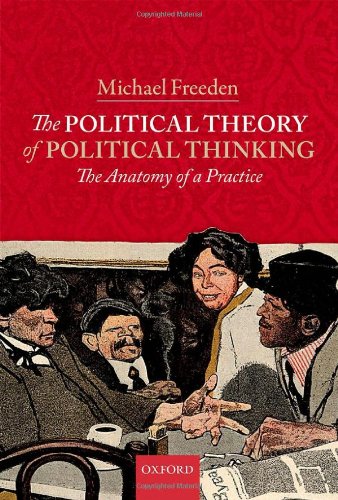
The Political Theory of Political Thinking The Anatomy of a Practice 1st Edition by Michael Freeden 9780199568031 0199568030


Original price was: $50.00.$35.00Current price is: $35.00.
The Political Theory of Political Thinking The Anatomy of a Practice 1st Edition by Michael Freeden – Ebook PDF Instant Download/Delivery:9780199568031, 0199568030
Full download The Political Theory of Political Thinking The Anatomy of a Practice 1st Edition after payment
Product details:
ISBN 10: 0199568030
ISBN 13: 9780199568031
Author: Michael Freeden
What does it mean to say that human beings think politically, and what is distinctive about that kind of thinking? That question is all-too infrequently asked by political theorists, or is dealt with through generalizations, abstractions, and dichotomies. This study examines the actual, real-world patterns people display when thinking politically, identifying six features of political thinking. They include the role of making ultimate decisions and regulating all social affairs, ranking collective priorities, mobilizing support for groups or withholding it, conceptualizing social order and stability as well as disorder and instability, projecting future visions and constructing plans for a society, and engaging the power aspects embedded in language, by means of reason, rhetoric, emotion or menace. Concurrently the untidiness and occasional failures of thinking politically are acknowledged alongside its quest for neatness. A large number of case studies is employed, drawn both from professional political theorists and philosophers and from various instances of vernacular usage: politicians, political commentators, or protest groups. Both contemporary and historical evidence from different cultures is utilized in illustrating the theoretical framework of the book. This is the first systematic study of political thinking as a cluster of thought-practices, combining insights from political theory–traditional and recent–the study of language and discourse, and political science. This investigation of ‘the political’ as a mode of thinking challenges many conventional understandings of political thought in the current literature, teases out what is political–not philosophical or ethical–in political theory, and locates it as a complex and ubiquitous social practice present at all points of human interaction and at diverse levels of articulation.
The Political Theory of Political Thinking The Anatomy of a Practice 1st Table of contents:
1. Thinking politically
2. Paths not taken
3. The mission in method
4. A preliminary note on ‘realism’
1. Theorizing about Political Thinking
1. The finality quest of politics
2. Pinpointing the political
3. Political theory: older and newer contenders
4. Thinking politically and its features
5. Competing methodologies
6. Changing conceptions of the political: The popular and the professional
7. Consensus meets conflict
8. Political theory and political science
9. Theorizing about mainstream practices
10. Fragmentation, division, obfuscation: The political confronts indeterminacy
a. ‘Real’ politics
b. The democratic mission
c. Disrupting the ‘political’?
2. Language, Emotion, and Political Thought
1. Beyond logos and logic
2. The interpretative flexibilities of language
3. Linguistic pluralisms and semantic interconnections
4. The emotionality of thinking politically
3. The Arrogance of Politics
1. Finality as temporality
a. The political as Godly
b. Earthly Gods: echoing the ‘big bang’ of politics
c. The secular originary
d. The case of nationalist ideology
2. The spatial parcelling of competences
a. The discursive management of social conduct
b. Drawing the line
3. Sovereignty, authority, and legitimacy
a. The compelling ubiquity of sovereignty
b. Authority and legitimacy: the pursuit of political gravitas
4. Ranking and the Distribution of Significance
1. The choice of values and the value of choice
2. Rights: the ranking device par excellence
3. The chimera of incommensurability?
4. Zero-sum intractability: the case of abortion
5. Choice versus life: an American story
6. The Danish cartoons
7. A note on urgency
8. Emotions and ranking
5. The Scramble for Acceptance: Mobilizing and Withholding Support
1. Conceptualizing support
2. The semantic limitations of political obligation
3. Generality, asymmetry, supremacy
4. Levels and defences of (dis)obligation
5. Alternative terminologies of support
6. Commitment and loyalty
7. Support as trust
8. The morphological complexity of support: professional and vernacular perspectives
9. Ceremonial performativity as a language of support
6. Stability, Order, and Disruption: Discourses of Balance and Contention
1. Digging under stability
2. Order and disorder
3. Political order and coherence
4. Stability and instability
5. Stability in America
6. Four normative genres
a. Constitutions
b. Deliberative democracy
c. Reasonable stability
d. The ethics of order
7. The order of disorder
8. Negotiating towards stability
7. Visions and Prescriptions: Temptations and Failures of Political Thinking
Part one: Living in the future
1. Untrodden trajectories
2. Planning as promise and inspiration
3. Science and utopia
Part two: Endemic failures of political thinking
1. Three criteria of failure
2. The asymmetry of failure and success
3. Uncontrollable and absent temporal trajectories
4. The limits of determinacy
5. The elusiveness of inclusiveness
6. Normalizing failure: from conservative fatalism to liberal epistemology
8. Power Patterns and Power Surges: Organizing and Intensifying Speech Acts
1. The immanent power of language
2. Performative speech acts
3. Reason and reasoning
4. Rhetoric
5. Emotion
6. Menace and threats
7. Refacing power
8. Past intensities
9. Ranking and intensity
10. Non-verbal power: a note
Epilogue
Bibliography
Index
People also search for The Political Theory of Political Thinking The Anatomy of a Practice 1st :
what is political theory
what is political theory in political science
what is politics in political theory
what is political theory and political philosophy
what is the role of political theory in politics
the political theory is based on the ideas of
Tags: Michael Freeden, Political, Theory