

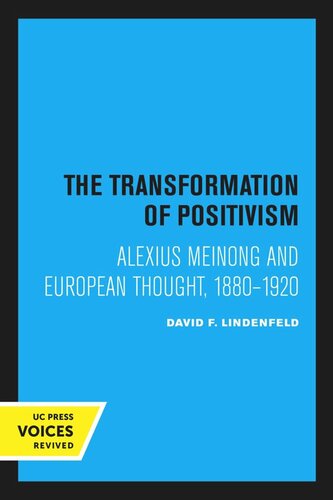
The Transformation of Positivism 1st edition by David Lindenfeld ISBN 0520312173 9780520312173
Original price was: $50.00.$35.00Current price is: $35.00.
The Transformation of Positivism 1st edition by David Lindenfeld – Ebook PDF Instant Download/Delivery: 0520312173, 9780520312173
Full download The Transformation of Positivism 1st edition after payment
Product details:
ISBN 10: 0520312173
ISBN 13: 9780520312173
Author: David Lindenfeld
European intellectual history of the late 19th and early 20th centuries presents a picture of extraordinary creative richness. Many historians have looked at this period as one of a “revolt against positivism in the attempts of thinkers such as Freud, Weber, Dilthey, and Durkheim to encompass and submit to strict investigation the irrational aspects of human behavior. At the same time, however, other thinkers such as Russell, Frege, Husserl, Wittgenstein, and Meinong were seeking to revise and expand the notion of reason itself through investigation of language and its relation to logic and psychology; this trend might be seen as a “revolt within positivism.” David Lindenfeld shows that these two trends were integrally related in the thought of the Austrian philosopher Alexius Meinong, and that he was representative of the major trends of the age. Meinong played a role in several intellectual movements which are now thought of as distinct. He, like Husserl, studied under the philosopher Fraz Brentano, whose ideas inspired the phenomenological movement. In addition, however, Meinong exerted a decisive influence on Bertrand Russell in the early 1900’s and thus also figures prominently in the history of British analytical philosophy. Furthermore, he developed a theory of values and their meaning which dealt with many of the issues raised by German social philosophers such as Weber and Dilthey. Finally, Meinong has an acknowledged place in the history of psychology, where he is cited as a precursor of the Gestalt psychology of Wertheimer, Kohler and Koffka. The first part of The Transformation of Positivism locates the background of Meinong’s thought in the long-run traditions of British empiricism as well as in the political and social conditions of Austria in the late 19th century. The second part traces Meinong’s intellectual development as he participated in the movement away from “psychologism”–the tendency to reduce all philosophical and social questions to psychological ones. After 1900, Meinong moved to a new concern with language and semantics, culminating in his “theory of objects.” The third part shows how positivism, experimental psychology, and phenomenology developed away from Meinong’s concepts to emerge as distinct, even opposed, by the 1920’s. This title is part of UC Press’s Voices Revived program, which commemorates University of California Press’s mission to seek out and cultivate the brightest minds and give them voice, reach, and impact. Drawing on a backlist dating to 1893, Voices Revived makes high-quality, peer-reviewed scholarship accessible once again using print-on-demand technology. This title was originally published in 1980.
The Transformation of Positivism 1st Table of contents:
INTRODUCTION
I THE TREATMENT OF MIND IN THE EMPIRICIST TRADITION
2. THE ANALYTICAL APPROACH
3. THE INTROSPECTIVE CRITERION
4. POSITIVISM IN THE MID-NINETEENTH CENTURY
II POLITICS AND PHILOSOPHY IN AUSTRIA IN THE LATE NINETEENTH CENTURY
1. THE POLITICAL AND INSTITUTIONAL SETTING
2. THE CAREER OF FRANZ BRENTANO (1838-1917)
3. BRENTANO’S IDEAS
III MEINONG’S LIFE AND CAREER
IV THE PSYCHOLOGISM OF THE 1880s
1. EMPIRICISM AND THE PHILOSOPHY OF SCIENCE: ERNST MACH
2. MEINONG’S EARLY PSYCHOLOGISM AND HIS THEORY OF MENTAL OPERATIONS, 1877-1890
V THE REVOLT AGAINST PSYCHOLOGISM, 1890-1905
i. THE PHILOSOPHY OF MATHEMATICS AND LOGIC: FREGE, HUSSERL, BOLTZMANN
2. THE REVOLT AGAINST PSYCHOLOGISM IN THE SOCIAL SCIENCES: JAMES, WEBER, DILTHEY
3. MEINONG’S OVERCOMING OF PSYCHOLOGISM: THE EMERGENCE OF THE THEORY OF OBJECTS OF A HIGHER ORDER, 1890-1899
4. MEINONG’S ANALYSIS OF TIME AND HIS REVISION OF THE INTROSPECTIVE CRITERION, 1894-1906
VI THE LINGUISTIC ANALOGY AND THE THEORY OF OBJECTS
i. LANGUAGE AND LOGICAL REALISM
3. FROM OBJECTS OF A HIGHER ORDER TO GEGENSTANDSTHEORIE, 1899-1904
4. MEINONG ON TRUTH, APPREHENSION, AND KNOWLEDGE, 1905-1915
VII MEINONG’S THEORY OF VALUE AND THE HERMENEUTICAL TRADITION
1. THE GERMAN METHODOLOGICAL CONTROVERSY AND THE CONCEPT OF VALUE
2. MEINONG AND WEBER ON CAUSALITY
3. MEINONG’S THEORY OF VALUES AS OBJECTS OF EMOTIONAL EXPERIENCES
4. MEINONG ON RELATIVE VERSUS ABSOLUTE VALUES
VIII MEINONG AND ANALYTICAL PHILOSOPHY
1. RUSSELL’S THEORY OF DESCRIPTIONS
2. WITTGENSTEIN AND LOGICAL ATOMISM
3. LOGICAL POSITIVISM
IX MEINONG AND EXPERIMENTAL PSYCHOLOGY
i. PHILOSOPHY AND PSYCHOLOGY IN GERMANY AND AUSTRIA
2. MEINONG AND THE WÜRZBURG SCHOOL
3. THE GRAZ SCHOOL AND GESTALT PSYCHOLOGY
X MEINONG AND PHENOMENOLOGY
1. MEINONG AND HUSSERL: PERSONAL CONTACTS AND RELATIONSHIPS
2. DIFFERENCES IN STYLE AND BASIC IDEAS
3. IDEALISM AND THE ANALYTICAL APPROACH
4. THE REJECTION OF ATOMISM AND THE PURE EGO
5. MEINONG, PHENOMENOLOGY, AND EXISTENTIALISM
CONCLUSION
BIBLIOGRAPHY
Index
People also search for The Transformation of Positivism 1st :
the theory of positivism
the positivist paradigm
the positive philosophy
the positivists were known for
what is the theory of positivism
Tags: David Lindenfeld, The Transformation, Positivism