

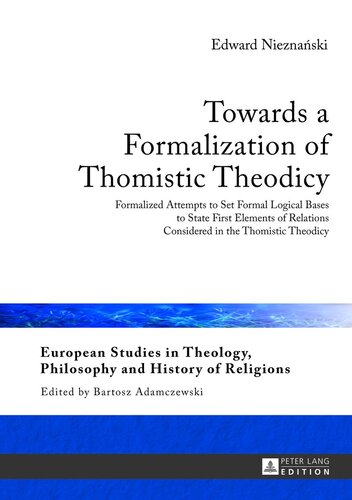
Towards a Formalization of Thomistic Theodicy Formalized Attempts to Set Formal Logical Bases to State First Elements of Relations Considered in the Thomistic Theodicy 1st Edition by Edward Nieznanski ISBN 3631623399 9783631623398


Original price was: $50.00.$35.00Current price is: $35.00.
Towards a Formalization of Thomistic Theodicy Formalized Attempts to Set Formal Logical Bases to State First Elements of Relations Considered in the Thomistic Theodicy 1st Edition by Edward Nieznanski – Ebook PDF Instant Download/Delivery: 3631623399, 9783631623398
Full download Towards a Formalization of Thomistic Theodicy Formalized Attempts to Set Formal Logical Bases to State First Elements of Relations Considered in the Thomistic Theodicy 1st Edition after payment
Product details:
ISBN 10: 3631623399
ISBN 13: 9783631623398
Author: Edward Nieznanski
The aim of the book is to gauge the possibilities of formalization of the Thomistic Theodicy. The benefits of such formalization attempts may be mutual, both in applied logic and the formalized field. Concerning formal logic on the linguistic improvements in all areas of science, formalization attempts provide useful material that can be applied to develop semiotics of the Thomistic language.
Table of contents:
1. Preliminaries
1.1. Introductory remarks
1.2. Introducing auxiliary terms
1.2.1. ‘Formalized language’
1.2.2. ‘Relational system’
1.2.3. ‘Language semi-model’
1.2.4. ‘Model for a set of formulae’
1.2.5. ‘Semi-models and proper models’
1.2.6. ‘Calculus (formal theory)’
1.2.7. ‘Interpreted calculus (formalized theory)’
1.2.8. ‘Formalization’
2. Basic Arrangements
2.1. Subject of the treatise
2.2. Aims of the treatise
2.2.1. Objectives overview
2.2.2. Obstacles in the realization of the objectives
2.3. Structure of the treatise
Part One: Proposal for a Formal-Logical Theory of First Elements of Relations
1. Auxiliary Arrangements
1.1. The notion of a relation
1.2. First and minimal elements of a relation
1.3. Images and restrictions of relations
1.4. Compositions and ancestral closures of relations
1.5. Transitive, asymmetric and irreflexive relations
1.6. Ordering relations
1.7. Cyclic relations
1.8. Multiplicative quasi-semilattices
2. Basic Theorems
2.1. Theorems on first and minimal elements of arbitrary relations
2.2. Theorems on first and minimal elements of relations of certain types
2.2.1. Connections between first and minimal elements in asymmetric, irreflexive or total relations
2.2.2. Uniqueness of a first element in asymmetric or irreflexive relations
2.2.3. First elements of functions
2.2.4. First elements of transitive relations
2.2.5. First and minimal elements of ordering relations
2.2.6. First and minimal elements of cyclic relations
2.2.7. Dense orderings and the existence of first and minimal elements
Part Two: Formalization of Findings of the Thomistic Theodicy About Stating the Existence of First Efficient Being
1. Presentation, Comparison and Evaluation of Existing Formalizations
1.1. Attempts to Formalize Findings of the Thomistic Theodicy About the Existence of the First Mover
1.1.1. Jan Salamucha’s calculus
1.1.2. Proposals of I.M. Bocheński for improvements of Salamucha’s calculus
1.1.3. Three formalisms of J. Bendiek
1.1.4. The first formalization of F. Rivetti Barbò
1.1.5. I. Thomas and P. Selvaggi’s proposals to improve the first formalization by F. Rivetti Barbò
1.1.6. Formalization attempt by Z. Zdybicka
1.1.7. Second formalization by F. Rivetti Barbò
1.1.8. Findings of B.L. Clarke and the calculus by K. Policki
1.1.9. Formalization contributions by L. Larouche, W. Marciszewski, C.H. Keiser and G. Klaus
1.2. Contributions to the Formalization of Findings About the Existence of the First Efficient Cause
1.3. Contributions to Formalize Findings of the Thomistic Theodicy on the Existence of the Ultimate
1.3.1. Formalization of philosophical findings about different kinds of existence and being
1.3.2. Contributions to the formalization of the incidence argument
1.4. Formalization Achievements in the Non-Thomistic Theodicy as a Contribution to the Formalization
1.4.1. In particular, special attention should be paid to attempts to formalize the so-called ontic …
2. Author’s Own Formalization Attempts Inspired by Issues of the Thomistic Theodicy
2.1. The issue of the First Being in the formalized theory of necessary conditions for existence
2.2. A significant extension of the theory of necessary conditions for existence to the calculus …
2.3. Assumptions of the Thomistic Vision of the World
2.3.1. Assumptions of theism – overview by Hartshorne
2.3.2. Selection of assumptions of the Thomistic vision of the world
2.3.3. Consistency of the Thomistic vision of the world
People also search for:
towards a formalization of thomistic
towards a typology of soviet mass housing
what is a formalist theory
a formal theory of differentiation in organizations
canonization of thomas more
formalist theory of language development
Tags: Edward Nieznanski, Formalization, Thomistic Theodicy, Formal Logical Bases, Relations