

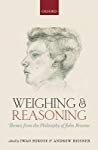
Weighing and Reasoning Themes from the Philosophy of John Broome 1st edition by Iwao Hirose, Andrew Reisner 0199684901 9780199684908

Original price was: $50.00.$35.00Current price is: $35.00.
Weighing and Reasoning: Themes from the Philosophy of John Broome 1st Edition by Iwao Hirose, Andrew Reisner – Ebook PDF Instant Download/Delivery: 0199684901, 9780199684908
Full download Weighing and Reasoning: Themes from the Philosophy of John Broome 1st Edition after payment
Product details:
ISBN 10: 0199684901
ISBN 13: 9780199684908
Author: Iwao Hirose, Andrew Reisner
John Broome has made major contributions to, and radical innovations in, contemporary moral philosophy. His research combines the formal method of economics with philosophical analysis. Broome’s works stretch over formal axiology, decision theory, philosophy of economics, population axiology, the value of life, the ethics of climate change, the nature of rationality, and practical and theoretical reasoning. Weighing and Reasoning brings together fifteen original essays from leading philosophers who have been influenced by the work and thought of John Broome. It aims to offer a comprehensive evaluation of Broome’s wide-ranging and far-reaching philosophical works over the past thirty years. The volume comprises two parts. The first part is focused on Broome’s work on the theory of value, as exemplified in his books Weighing Goods, Weighing Lives, Economics out of Economics, and Climate Matters. The second part is focused on his work on practical and theoretical reasoning, which culminated in his Rationality through Reasoning. This volume also includes a piece by Broome on his intellectual history to date.
Weighing and Reasoning: Themes from the Philosophy of John Broome 1st Table of contents:
Part I: Weighing
1: Liberty, Preference Satisfaction, and the Case against Categories
IIntroduction
II The Arrow Case
III Sen´s Agenda and the Dubious Relevance of `Impossibility´
Paretian feasibility
Feasibility of liberalism
IV Sen: Rights vs Exchange?
V Sen vs Coase vs Optimal Compromise?
VI Conclusions
References
2: Challenges to the Principle of Personal Good
I
II
III
IV
V
VI
VII
VIII
IX
X
References
3: Metasemantics out of Economics?
Radical Interpretation
Social Choice Theory
Back to Radical Interpretation
Concluding Remarks
References
4: Separability
1 Introduction
2 Separability-based Argument
3 Doubt about Separability of Time
4 Dispersing the Disvalue of Premature Death
5 Temporal Good Makes Sense?
References
5: The Social Disvalue of Premature Deaths
1 Extant Approaches to Valuing Life
2 Broome on the Disvalue of a Premature Death
2.1 Against willingness to pay
2.2 Quality-adjusted life years and wellbeing-adjusted life years
3 Social Disvalue
4 Death and Overpopulation
5 Conclusions
References
6: Being and Wellbeing
Guardian Angel Arguments
Primitive Absolute Wellbeing?
Concluding Remarks
References
7: On the Social and Personal Value of Existence
Introduction
1 The Alleged Absurdity of the Claim that Existence is Better Than Never Existing
2 Others´ Responses to the Argument
3 Why It Is Not Absurd to Claim that Existence Is Better Than Never Existing
4 A Difficulty for Other Views
5 Implications for Population Ethics
6 Challenges to Our View
7 A Challenge to Welfare-based Approaches to the Value of Existence
References
8: The Affirmative Answer to the Existential Question and the Person Affecting Restriction
I Introduction
II The Person Affecting Restriction
III The Restriction and the Affirmative Answer
IV Subjunctive Weak Pareto
V The Repugnant Conclusion
VI The Person Affecting Restriction and Population Ethics Reconsidered
References
Part II: Reasoning
9: The Meaning of `Darn it!´
1 The einmal-ist-nicht-keinmal Game
2 Twelve Types of Regret
3 Uncertainty Aversion and Uncertainty Proneness
4 Regret Avoidance Therapy
Appendix
References
10: Keeping Things Simple
1 Reasons and Parsimony
2 Reasons, Explanation, and Ought
3 Ought
4 Favouring and Weighing
5 Objective and Prospective Oughts
6 The Central Ought and Rationality
7 Objective and Subjective Oughts
References
11: Moral Requirements
1 Broome´s Use of `Require´ and `Ought´
2 An Alternative Use of `Require´ and `Ought´
3 An Account of the Nature of Moral Requirements
4 Implications of the Account
References
12: Reasons for Broome
1 Pro Toto Reasons
2 Pro Tanto Reasons
3 The for-F Role
4 Reasons and Explanations
5 Reasons and Oughts
6 Ownership of Reasons
References
13: Normative Conflicts and the Structure of Normativity
1 Introduction
2 Assumptions
3 Conflicts
4 Conflicts and the Structure of Normativity
4.1 Possible normative architectures 1: Basic and derivative normativity
4.2 Possible normative architectures: Combinations of views about basic normativity and types of rea
4.2.1 Architecture 1: Normative monism and reasons generalism
4.2.2 Architecture 2: Normative monism and reasons specialism
4.2.3 Architecture 3: Normative pluralism and reasons generalism
4.2.4 Architecture 4: Normative pluralism and reasons specialism
5 Conclusion
References
14: Reasons and Rationality
Introduction
1 Agency
2 Individual Coherence
3 Group Coherence
4 Group Agency
5 Escape Route 1: Group Agents Should be Practically Restricted
6 Escape Route 2: Group Agents Should Be Epistemically Restricted
7 Escape Route 3: Group Agents Are a Fiction
Conclusion
References
15: Weighing Explanations
1 Reasons as Normative Explanations, or Parts of Normative Weighing Explanations
2 The Objections of “Reasons: Explanations or Evidence?´´
i. The deliberative role of reasons.
ii. The “for-F role´´ in normative weighing explanations.
iii. The mystery of the weight of reasons.
iv. Ambiguity concerning “reason,´´ or defining “reason´´ disjunctively.
v. Too few reasons.
vi. Ought and evidence.
vii. Fundamental ought facts.
3 Weighing Explanations
Mechanical weighing explanations
Broome´s examples of normative weighing explanations
Some other explanations
Are our examples weighing explanations?
If our explanations are not weighing explanations, then neither are Broome´s
Where to go from here?
People also search for Weighing and Reasoning 1st:
john broome philosophy
weighing reasons moral philosophy
normativity and rationality
practical reason decision theory
contemporary analytic philosophy
Tags: Weighing, Reasoning Themes, Philosophy, John Broome, Iwao Hirose, Andrew Reisner